It’s been a great year for records- and we’re finally seeing one for the streaming arena, too. Netflix has always had a great hit on its hands with Stranger Things, and the first episodes of Season 4 have managed to set a brand new record for U.S streaming. Blake & Wang P.A entertainment lawyer, Brandon Blake, fills us in.
In just one week- May 30th through June 5th- the 32 episodes of Stranger Things season 4 has managed to rack up 7.2B minutes of streaming. This breaks Netflix’s Tiger King’s record from May 2020 for the most U.S streaming minutes in a single week. It’s worth noting that this is without the penultimate and final episodes, too.
The announcement that the series will end in Season 5 probably had a hand in driving demand, but that’s still impressive.
Obi-Wan Draws Crowds
The Star Wars IP spin-off, Obi-Wan Kenobi, is also carving itself as a breakthrough original, despite skewing to a male audience. It has managed to pick a lot of traction up through the age tiers, however, playing almost evenly from 18-64 years of age. It managed to hit almost 1B viewing minutes, despite only three episodes being available in that same period.
It’s also worth remembering that Nielsen still only tracks minutes watched on a TV screen for streaming, so the overall picture is likely even rosier for both IPs.
While there hasn’t been the same concern for the strong streaming industry that we’ve seen for the theatrical box office, seeing this level of engagement and traction from two solid series is always a welcome sight. Hopefully there will be plenty more to come as we move forward into an invigorated film and TV landscape.
Reconnaissance Energy Africa is an oil and gas company established in Canada. It found its basis in 1978 with the head office in Vancouver, Canada. It is a huge production company working hard to produce an extensive reservoir of gas and oil in Namibia and Botswana. It is a registered company and works collaboratively with all the national governments. It aims at exploring and searching the potential gas and oil in North East and North West Africa.
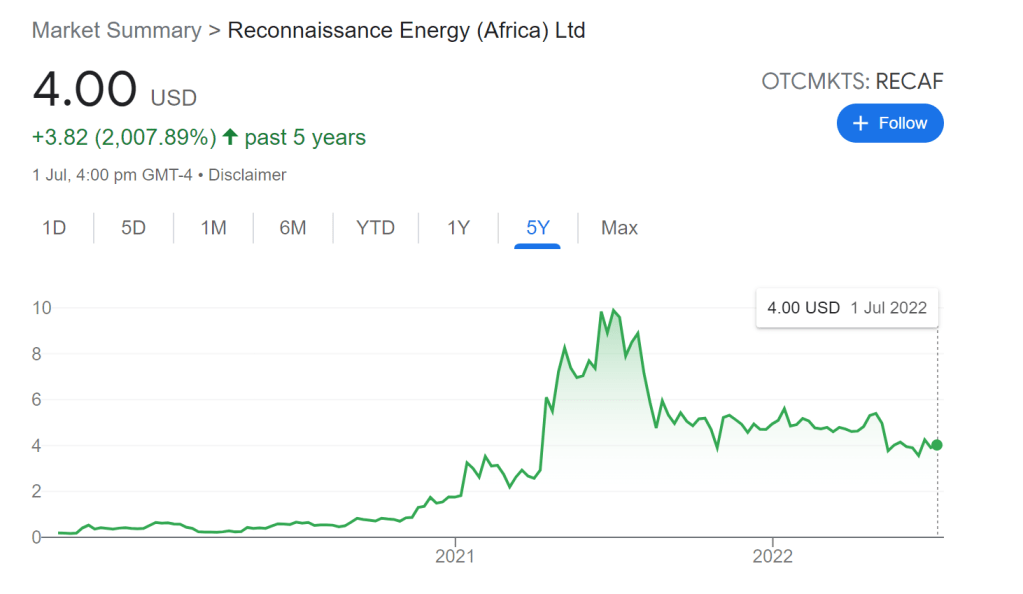
This company presents its outstanding shares named RECAF Stock with the current price of 4.00 US dollars. Moreover, the operations in the company are carried out by a technical team. They have the specialized expertise required for the exploration of gas and oil. These include geophysicists, Geoscience advisors, geologists, and advisory committee members. All of them fulfil the specific operations and represent the academic reports.
Business Overview:
The business activities of Reconnaissance Energy are led by a team of efficient directors and officers. They all have extensive experience with African resource exploration and development. The company is engaged in drilling conventional wells in a low-impact 2D seismic program. It wants to provide a complete picture of the geological formations in the different areas using the latest technological methods. This conventional drilling program does not intend for the wells to produce the flowing oil.
They hold the significant market core segments as they are leading towards success. However, all the samples that have been collected during the mining and drilling process are collected and presented to the higher authorities related to mines and energy. This company holds good community relations and performs its functions according to community standards. It assures the safety and health of all the workers and can be a good source of employment.
RECAF Stock:
Here is a detailed view of the fluctuations, increasing, and decreasing patterns in the RECAF Stock. Please have a look at this to know more about this.
1-Current Stock Price:
The current price of RECAF Stock is 4.00 US dollars on July 7, 2022. In the previous five days, the price was maximum with a rate of 4.50 US dollars on June 29, 2022. It decreases to 3.86 US dollars on June 30, 2022.
2-Stock Volatility Or Stability:
The record of RECAF Stock indicated the maximum rates and stability of stock on April 16, 2021, May 7, 2021, and May 14, 2021, which are 6.10, 8.26, and 7.38 US dollars. Moreover, the stock prices are the highest on the following dates.
May 21, 2021
May 28, 2021
June 4, 2021
June 11, 2021
June 18, 2021
June 25, 2021
July 2, 2021
3-Maximum Stock Price In The Last 5 Years:
The maximum stock price in the last five years was 9.89 US dollars on July 2, 2021.
4-Minimum Stock Price In The Last 5 Years:
The last five years’ minimum stock price was 0.19 US dollars on October 16, 2019.
Financial Statement Analysis:
The financial condition of any company plays a vital role in its success. Financial statement analysis reports economic conditions and all the business activities. So, Let’s look at this company’s financial statement analysis.
Earnings:
This company’s earnings have declined by 125.6% per year over the past Five years. The payments are 21.08 Million US dollars in the year 2022.
Revenues:
This company started generating revenues in the year 2022. From the year 2018 to 21, there were no revenues. Though, it will create revenues of 2.66 Million Us Dollars in 2022.
Debt To Equity:
The debt to equity ratio gradually reduces from the end of the year 2019. First, it was 5.6% at the end of 2019, and it declined to 0% in the year 2022. Hence, the debt to equity ratio is 95.99 Million US dollars.
Liabilities:
According to the research, the short-term liabilities range from 42.31 Million Us Dollars, and the long-term liabilities are 0.82 million US dollars.
Assets:
The short-term assets are 89. 45 Million Us Dollars and long-term assets are 49.66 Million US dollars. All the short and long-term assets cover the liabilities.
We’ve seen a lot of movement in the theatrical industry of late, with chains trying various innovations to try to reshape and boost the industry without discouraging viewers. This week we see Cineplex bring another twist to the table. Blake & Wang P.A entertainment lawyer, Brandon Blake, unpacks the news.
In an attempt to bolster the slow post-pandemic recovery, Cineplex will now charge a $1.50 booking fee for tickets purchased online, both through their website and the mobile app. This charge will not apply to on-site purchases at ticketing kiosks, box offices, or for any consumables added to your bill. Currently, they’re presenting it as a quality-of-life upgrade aiming to invest and evolve the chain’s digital infrastructure while keeping movie going affordable.
Echoing Ticketing Industries
The idea of an online booking fee is hardly novel at this point, although it’s a first for the theatrical industry specifically. Most ticketed fare, from live theater and concerts to sporting events, already use a similar system.
For regular theatergoers using the Scene+ loyalty program, the fee drops to $1, and members of CineClub will have it waived in full. This also brings Cineplex into line with AMC’s online surcharge. AMC are also currently using surge pricing in an experiment that’s been ongoing since the release of The Batman earlier this year.
These initiatives are, of course, subtly prodding regular theatergoers towards their subscription ticket programs, a model we’re likely to see echoed through other chains soon.
The cautious dance between trying to bolster the industry’s bottom lines without scaring off the returning movie going public is an interesting one. While this new introduction has a lot of backing in the wider ticked-event world, it will be interesting indeed to see how the theater-going public respond in turn.
There’s much talk of a recession coming, at least in the news headlines. While we’ve yet to see particularly compelling evidence of this come through in anything but the gloomy media cycle, many investors and businesses alike are taking soundings and preparing to batten down hatches. While Netflix has taken a battering of its own in recent months, there’s some evidence that suggests it may still be favorably positioned enough to weather a recession well. Blake &WanyP.A entertainment lawyer, Brandon Blake, looks at this stance.
Tech Stocks Worst Hit, Entertainment a Safe Harbor
In brutal honesty, the entertainment industry itself likely has little to fear from a ‘recession climate’. Where we’re seeing the most stock-related issues is in the tech market, always a fickle landscape for booms and busts alike. However, the trends being looked for- free cash flow, decent growth potential, and reasonable prices, with less stock-based compensation- are all hallmarks of stocks likely to perform well in a downturned bear market.
Historically, entertainment does perform well in this sort of market, becoming a safe harbor (of sorts) for investors. However, we do definitely have an environment that’s running very saturated in streamers, and it’s inevitable the pecking-order battles we’ve seen accelerate over recent months as the ‘free growth’ cycle ends and subscriber saturation becomes a real issue will weed out the fittest and strongest in the event of such a downturn. The million-dollar question is- who will that be?
The Surprising Argument FOR Netflix
This hasn’t been Netflix’s year. Amidst some (often deserved) criticism for lukewarm content and abrupt heel-turns on their sharing policy, Netflix’s subscriber losses in Q1, with more anticipated to come, have not made it the most compelling entertainment asset in the market. However, they have one thing that may prove invaluable if we truly do enter a space where consumers begin to jettison entertainment expenditure and tighten their budgets- a widespread and saturated consumer base that, if usage statistics can be trusted, still has a lot of traction. Their brand may have taken a hit in recent months, but it’s still one of the best-known streaming brands in the space. Additionally, their recent stock dips have sliced a lot of top-heavy value off their buying price.
While nothing is set in stone in entertainment or the markets, those two factors could well position Netflix for a rebound in a tight economic environment- if they manage to address the trust and content issues that have been raised, that is.
Candy, a limited series under the Hulu banner designed to roll out over a week in a daily episode release, has managed to carve itself a spot on the Nielsen weekly chart for May 9th-15th. Earning Hulu a best debut title it hasn’t claimed since the release of the latest The Handmaid’s Tale season, it’s an impressive undertaking. Entertainment attorney from Blake & Wang P.A, Brandon Blake, takes a look at the rest of the top 10.
Despite this rather marvelous grab from Hulu, the rest of the spots were heavily dominated by Netflix. Ozark takes an unsurprising lead with a hefty 1.73B minutes of viewing. Their new original series, The Lincoln Lawyer, based on the Michael Connelly novel of the same name, slid into second at 884M viewing minutes.
The ‘bronze’ spot belongs to Senior Year, a Rebel Wilson comedy that managed to claim 797M viewing minutes, not bad for a film among series. Despite the Netflix dominance, with Cocomelon (715M min.); Grace And Frankie (584M min.); Criminal Minds (546M min.) NCIS (539M min.); Workin’ Moms (512M min.) and Our Father (450M min.) all making an appearance, it’s hard not to see Candy as the real winner. Its 6th-place debut with 577M minutes watched is notably impressive for an unorthodox release, and it managed to sustain at least 25M minutes apiece for every one of the subsequent episodes, mostly pulling in the 35-49 female demographic.
Nielsen Chart Demographics
This chart data is assembled by Nielsen based on US streaming through TV devices, meaning mobile statistics are not present in the data. It reports across Hulu, Netflix, Apple TV+, Disney+, and Amazon Prime. There’s a delay of about a month in the released data.
Intriguingly, this means we’re looking back at what was trending right as Netflix was hit by its now-notorious poor first-quarter earnings call and the fallout from this. In fact, this was the very week when they were being threatened by a lawsuit for non-disclosure of pertinent financial facts. We can’t draw too many conclusions from one week of viewing, of course, but it’s interesting to see their domination of the charts for that week all the same.
In yet another interesting partnership as streamers fight for recognition and subscriber interest in a crowded marketplace, we see Vice Media Group send their free, ad-supported streaming channel, Vice FAST, to Fox’s streaming arm, Tubi. Blake & Wang P.A entertainment lawyer, Brandon Blake, shares the news.
The deal was struck by Vice Distribution, and will include 200 hours of new programming as well as the FAST channel deal. This means that Most Expensivest, The Devil You Know and Dark Side of the Ring will also debut on Tubi, alongside the tech, sports, and food fare Vice FAST is known for.
The appeal on Vice’s side appears to be additional growth in the TV-connected sector, capitalizing on Fox’s existing linear and broadcast appeal. Vice has been pursuing new market opportunities quite voraciously over the last 18-months, even pulling its Sky-bundled packages in favor of AVOD streaming opportunities.
New Market Movement
The licensing sector has become a hotbed of deals and movement in the same time period, with many seeking to eke out their own corner of the increasingly crowded streaming space. Many of the best-favored deals, as exemplified by Roku’s growing sway over the market, have seen some combination of free and AVOD/FAST programming combined with capitalizing on growth in sectors not already flooded by premium-tier subscribers and the bloody battle to keep new subscriptions rolling in. Sony, too, is capitalizing on its lack of a homegrown streamer to push solid licensing deals with a variety of platforms.
Is this a passing phase, or a stronger indication of where future market leaders will be pushing their content? For now, it’s too early to tell, but it’s certainly indicative of a shift in how streaming and streamers are being viewed globally, and could well open up some interesting market opportunities along the way.
Who exactly is going to buy Starz? This question has been hovering over the premium cable and satellite TV network (and fledgling streamer) for a while now. It’s been crystal clear that Lionsgate has been taking the time to ‘buyer-shop’ among interested parties, but the deal is starting to drag a little. Last week we saw them finally make an announcement about the future of Starz. Blake & Wang entertainment lawyer, Brandon Blake, sheds some light on the situation.
We still don’t have a clear buyer announcement, of course. However, we’ve been promised one by the end of summer, with the deal closing by spring. In fact, they teased that it could be as early as the end of fiscal quarter four. More M&A developments were also hinted at, for both Starz and Lionsgate overall, once the separation is finalized.
For people keen to see who will eventually take home the prize, it’s still a frustratingly vague announcement. Many names have been thrown into the hat in the last year. Roku has shown clear interest, as has Canal+ (part of the Vivendi conglomerate). Apollo Global Management has been keen on acquiring a minority interest, while DirecTV was also tied to the deal by rumor.
Lionsgate Acquisition
Lionsgate itself took Starz over for a relatively-small $4.4B in 2016. It’s shown solid growth in the streaming arena, but failed to enhance its parent company’s bottom line by much. Hence their urge to spin it off, a move that could unlock greater value for both entities if done well.
Starz has been responsible for the bulk of recent subscription additions for Lionsgate, comprising 47% of the gain last year that has left them at 35.8M subscribers. StarzPlay International consortium has seen particularly good growth.
So far, we have a more concrete timeline and the knowledge that Lionsgate will retain a minority stake of their own. Still frustratingly vague, but definite progress on the deal. We’ll keep you informed as other updates arrive.
It’s not the easiest of eras for broadcast TV networks, but it seems they may have found at least one magic tool to help them stay relevant as competition grows. If the latest Nielsen data is anything to go by, that’s the power of the franchise. Brandon Blake, the entertainment lawyer at Blake & Wang P.A, takes a look at the data.
Going purely by Nielsen’s latest data, of the 20 most popular (scripted) series running at the moment, 12 were part of wider IP franchises. Up it to 13 if you want to argue Young Sheldon, once a Big Bang Theory spinoff, as another. There’s more to come, too, as ABC announces a Fall spinoff for The Rookie, too.
It’s the strongest possible indicator that broadcasters, at least, are hoping familiar storylines and beloved characters will be enough to entice viewers otherwise inundated with viewing choices on all sides.
Analyzing the Stats
How is it fairing for them? Nielsen data suggests CBS comes out ahead of the pack, with 4.2M views on average. There’s quite a drop off to NBC (3.2M), ABC (2.8M), and Fox (2M). Surprisingly, smaller broadcasters like Telemundo managed to represent, although not to break the 1M viewers threshold.
TNT came out ahead in the cable networks (likely due to the NBA playoffs) with 3.36M, followed by Fox at 2.2M and ESPN at a fraction over 2M. News-wise, ABC takes the lead, pulling in 7.5M viewers over the week period. NBC’s Nightly News managed 6.2M, and CBS’s Evening News 4.5M.
Overall, it’s clear that the beleaguered broadcast industry is sticking with ‘playing it safe’ in the scripted space and leveraging beloved IPs instead of trying to pull in new interest. While live sports and news continue to be massive drawcards, it’s otherwise a quiet environment with nothing daring being attempted to draw people away from streaming offerings.
In a deal that’s been teased since February, we’ve finally seen a formal announcement that UK-based telecom giant, BT Group, and Warner Bros Discover will be merging sports media units BT Sport and Eurosport in the UK and Ireland as a 50/0 joint venture. Blake & Wang P.A entertainment lawyer, Brandon Blake, unpacks what we know.
As we already expected, the existing content output funnel to the UK’s Pay-TV giant, Sky, will not continue, at least in its current form. While the merger is still a way off, we will instead see the combination of HBO Max with Discovery+ replace this in the British market.
The new venture, however, seeks to fit into the new entity’s push to enter different markets. WBD has been positioning itself as a ‘multi-product’, rather than a one-trick pony, in the streaming market for a while now.
The combination of two larger sports streaming entities in the UK will give it a powerful corner of the market to play with, too.
Existing Subscriber Swop-Over
Those who already access BT Sport as part of their wider BT packages will receive Discovery+ in its stead, with both live and on-demand sports streaming on offer. Both entities will funnel their existing sports rights and distribution agreements to the new entity, while WBD will assume direct command of BT Sport’s operating businesses. BT will net $114 million (£93 million) from WBD, as well as an approximate earn-out of around $659 million (£540 million), although there are attached conditions. Likewise, BT retains a 50% interest in the joint venture. WBD receives a call option over that interest, however, to be exercised at specific points in the first four years.
It’s a pretty major shift in the UK’s live sports landscape, with the top leagues of English soccer, cricket, and rugby entering the scene. BT wishes to roll back focus to its telecommunications business, and BT Sport has underperformed for them to date. Meanwhile, WBD scores an interesting foothold on live sport in the key European destination. It will certainly be interesting to see how the scene develops from here.
Doctor Strange in the Multiverse of Madness is certainly a much-anticipated entry into both the Disney/Marvel catalog and the summer Box Office. Much anticipated as a three-pronged sequel, tying together loose ends from Loki and WandaVision as well as Spider-Man: No Way Home, it is anticipated as one of the biggest performers of the 2022 summer season. Blake & Wang P.A entertainment attorney, Brandon Blake, looks at its starting potential, and how it weighed against reality.
This will also be one of the widest rollouts of the post-pandemic era, with 4,400 domestic theaters hosting the film. With this in mind, a target of $160M to $180M was set for its domestic opening. It still managed to outperform the target, netting $185M domestically in its opening weekend. This catapults it to the second-best Box Office debut of the current era, with only Spider-Man: No Way Home to beat it.
Weekend pre-sales for the U.S and Canada stood at $60M, placing it ahead of The Batman at the same point in its sales cycle. However, the bulk of these were for Thursday night, not the opening weekend, which does suggest a little frontloading. All the same, it’s an impressive achievement.
Chasing $300M Globally
How likely was it to achieve these targets? That heavily depends on how compelling it is among non-Marvel fans- to which the answer was, apparently, very. It was hoped that the addition of Wanda to the lineup, played by Elizabeth Olsen, could give it pulling power among younger women, a demographic often missed by the MCU titles. The return of Sam Raimi to the director’s chair was anticipated as another drawcard.
Additionally, the film was hoping to add at least another $140M to its international openings. This was projected without a release in China and Russia. It’s also highly unlikely to gain much traction in the Middle East, with open LGBTQ elements in the film’s storyline.
And it has managed to deliver. Unlike domestic figures, which remained more-or-less in the target range, it has managed to pull another $262.4M internationally, giving it an impressive $450M opening weekend globally, and putting it in the spotlight as the second-highest global opening of the pandemic era to date.